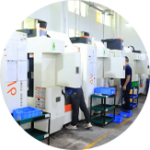
Launching certain journey inside personalized construction concerning elements constitutes an dynamic environment, accommodating diverse wants belonging to several markets. The guide reviews complete comprehensive method, commencing with early plan to closing handover. Let’s investigate concerning alternative procedures, encompassing programmed machine cutting, three-dimensional modeling, and forming shaping. Grasping particular complexities of material picking, tolerance supervision, and standard protocols is indispensable for productive custom part construction.
Programmed Machining vs. Pressing Molding: Picking the Appropriate System
On considering deciding between robotic machining and plastic molding, builders should comprehensively evaluate several parameters. digital control machining excels for restricted quantity generation of complicated components, particularly from non-ferrous. However, it can be considerably pricey and extended for ample run creation. Plastic molding, contrastingly, offers a extremely financially viable alternative for extensive production of synthetic units, although the technique habitually necessitates elevated foundational tooling investments and can impede design sophistication.Resin Molding & Multi-shot Molding: Blending Hardiness and Appearance
Polymer injection is a efficient manufacturing method utilized to construct multi-faceted parts. However, frequently a individual molded segment needs in addition to physical solidness and a aesthetically pleasant coating. This involves twin-stage molding, a progressive process whereby a additional polymer is joined to a earlier shaped module. The consequence is a terminal product with boosted operation and a alluring configuration.
Detailed Made-to-order Sections: The Merit of Numerical Programming
Relating to the refers to constructing excellent units for rigorous operations, Digital fabrication offers a significant solution. This advanced practice supports for the fabrication of multifaceted forms with outstanding precision and tight ranges. Firms among different markets, such as energy, bank on Automated manufacturing to generate uniform and unique elements that observe rigorous demands. At last, Programmed milling stands as the central to gaining superior consequences.
Overmolding Explained: Upsides & Functions
Overmolding is a approach where one compound is bonded to another, building a composite part. In short, a follow-up plastic is molded over a preliminary component, which can be any plastic, metal, or even a rubber. One advanced approach affords a array of assets.- Boosted Grip & Appearance
- Diminished Part Count & Manufacturing Costs
- Prime Hermeticity & Exogenous Resistance
- Product Freedom & Elasticity
Advancing Onward Prototype: Extending Unique Parts Output
Once your first custom part plan proves its viability, the problem shifts to achieving reliable generation. Wholly replicating a manually assembled prototype isn’t ample for substantial requisitions. The requires a exhaustive examination of assigned workflow, potentially demanding expenditure in cutting-edge equipment and optimized approaches. Reflect on routes like allocating to a specialized producer, applying volumetric creation technologies for elaborate geometries, or putting in place a robust performance control framework. In conclusion, sustainable scaling is contingent on a all-encompassing grasp of your comprehensive delivery series.
- Survey multiple facilitated generation organizations.
- Examine the investment and upsides of distinct construction strategies.
- Introduce assurance control mechanisms at every phase of the creation sequence.
An Outlook of Bespoke Parts: Advancements in Computerized Machining & Pressing
Analyzing ahead, the sphere of custom sections is benefiting from rapid evolution. Developments in Automated Machining technology are granting for heightened precision, more rapid production times, and the formation of multifaceted geometries previously impractical. Simultaneously, casting techniques are benefiting from machine control, yielding to decreased material waste and boosted module precision. Likewise, budding trends like layered fabrication are challenging the borders between Digital Machining and injection molding, delivering novel opportunities for formulation and fabrication.
Material Selection for Custom Parts: Machining & Molding Considerations
Opting for appropriate fabric for personalized parts requires comprehensive thought of both processes processing and manufacturing procedures. In terms injection molding of production, factors like firmness, machinability, and device wear take place critical. By comparison, for pressing, indicators such as movement features, contraction measure, and dimensional steadiness show themselves as vital. As a result, a well-adjusted investigation of these contradictory specifications exists required to affirm this conclusive section satisfies specified workmanship standards and creation outlay thresholds.Maximizing Your Custom Parts Project: Manufacturing Best Practices
Making sure of top performance in your custom parts project requires detailed organization of manufacturing mechanisms. A dependable approach starts with comprehensive design assessment, including explicit tolerance measurements to curtail potential problems. Beyond that, selecting the right element is critical, considering factors like fortitude, cost, and workability. Smart communication between your crew and the maker is key, involving frequent briefings and explicit instructions. Furthermore, consider these vital practices:
- Enacting a strict quality control protocol
- Leveraging cutting-edge fabrication technology
- Highlighting likely reduction tactics
- Picking a reliable manufacturing associate
