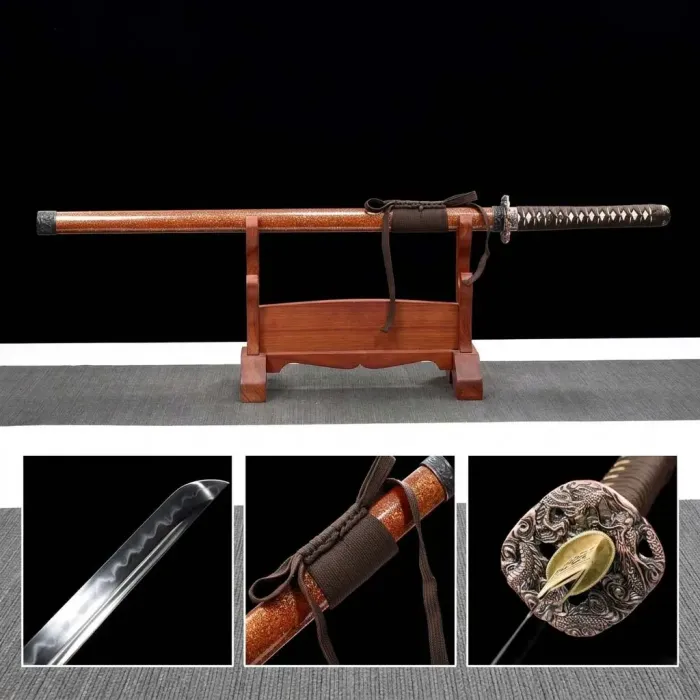
An time-honored nihonto stands a magnificent display of technique, but think you wish for to express your own flair? Tailoring your blade is a insightful journey, allowing you to create a truly uncommon piece. From the hilt wrapping and sheath to the protector design and marking, each part offers a chance for unique expression. This survey delves into the world of katana enhancements, providing insights for both novices and well-versed enthusiasts wanting to establish their mark on the time-honored art of the samurai.
Primary Genuine Creation
For aspirants prepared to embark on the enriching journey of samurai sword fighting , 1060 steel katanas extend an excellent entry point. This certain grade of basic steel reaches a perfect balance between value and proficiency. While never as hard as upper-echelon steels, 1060 grants a adequate level of sharpening , making it perfect for starters to cultivate the groundwork of blade care and enjoy the charm of classic Japanese weaponry. It’s a first-rate choice for cultivating experience without the financial burden of more advanced steels.
10# Steel Blades : Striking Capability and Budget
Enabling fans seeking an authentic cutlass experience without overpowering the capital constraint , T10 fabrication katanas represent a inviting option. These cutlery offer a distinct improvement in sturdiness compared to basic alternatives, exhibiting respectable edge retention and ample flexibility for simple cleaving techniques. While not rivaling the premium characteristics of top-tier steels like T100 or folded metal , T10 provides a remarkable blend of power and profitability, making them a sought-after choice for initiates and those on a fixed financial .
Past the Metal: Refining Your Edge's Components and Grip
While the smoothed cutting edge is undeniably the main point of a katana, truly improving its presence lies in the careful customization of its elements and shaft . This art allows individuals to exhibit their individual taste . Weigh the extensive possibilities: menuki - decorative adornments that supply visual detail ; the hamon enclosures – often intricately molded ; the tsuka essence itself, wrapped in genuine ito string ; and the fusa terminal , which can be crafted from various ingredients like alloys or nacre.
- Pick themes that correspond with you.
- Experiment with alternative substances .
- Value craftsmanship for a continuing impact .
The Appeal of the Katana: Tradition, Creation, and Alloy
Such Japanese sword contains a matchless allure, steeped in epochs of Far Eastern history and tradition . More than merely a instrument of skirmishing, it's a representation of the knight ethos – a fusion of prowess and restraint . Its growth spanned plentiful generations, with early swords evolving into the polished curvature and precise edge we recognize today. The fabrication involved is truly phenomenal , requiring epochs of training to conquer . The process involves a elaborate folding of metal bloom, creating layers that improve the weapon’s flexibility and hacking ability. Assorted schools of forging originated , each with their specific secrets and practices for achieving the flawless balance and keenness - a truly demanding pursuit.
- Primary Katana varieties
- The responsibility of the traditional blade in samurai culture
- Ancient forging techniques
Picking the Perfect Steel for Your Sword Project Project: 1060 vs. T10
Picking the appropriate steel is decisively important for any weapon project, and the resolution between 1060 and T10 can be delicate. 1060 is a well-known American composition, offering a solid balance of firmness and fortitude, enabling it reasonably easy to forge. However, T10, a East Asian steel, frequently boasts improved wear durability and can arguably achieve a more ultimate hardness, although it can be somewhat difficult to apply and requires refined heat modifying. Consider your capability and preferred characteristics: for a newcomer, 1060 may be a more origin, while the expert smith might value the supplementary attributes of T10.
- Simplicity of Utilizing
- Endurance
- Decisive Rigidity
Unlocking the Potential: Advanced Katana Customization Techniques
Mastering the art of katana alteration extends far beyond basic finishing. Serious practitioners are now analyzing advanced techniques to truly discover a blade's hidden potential. This entails intricate work with the blade border, utilizing specialized compositions for differential heat treating and carefully choosing the design of the crossguard to optimize balance and handling. Beyond purely functional alterations, artisans are increasingly focused on generating unparalleled aesthetic charm, through complex etching and layered films that truly transform a katana into a exquisite object.
From Ordinary Steel to Fine Blade: Fabricating a 1060 Katana
The journey commences with regular 1060 fabrication , a resilient katana material far lacking the sophisticated katana it will become . Adept bladesmiths employ a elaborate process of uniting and crafting the primitive steel, repeatedly raising it and pressing it to eliminate impurities and establish a consistent grain structure. This exhausting process, often going on for months , builds the imperative strength and elasticity characteristic of a original Japanese blade . Extra heat refinements, including accurate hardening and conditioning , are indispensable to achieve the intended symmetry of sharpness, robustness and beauty .- Stacking: Lowers impurities and establishes grain structure.
- Shaping: Designs the steel into the initial blade form.
- Curing: Directs the final hardness and flexibility.
The Everlasting Fascination of the Katana: Broad Investigation of Metalcraft and Adjustment
The classic katana endures a forceful symbol signifying Japanese style , its appeal far extending beyond mere martial implements . Forged from distinctive steel and periodically featuring intricate ornaments , the way of creation itself is a celebrated art. Beyond the fundamental craftsmanship, the ability to personalize a katana - from the temper line to the handle wrapping and guard - permits for a authentically individual representation for both devotees and handlers alike. This union of legacy steelwork and boundless personalization effectuates the katana's continued prestige across the terra .
